Wednesday, August 12, 2009


Back in the 1950’s and 1960’s, Marx® Toys (founded by Louis Marx &
Co.) was notorious for toys that tied in with television. One of such
examples is the Rat Patrol set produced in 1967.
Background on the show- From 1966-1968, the Rat Patrol series was in full motion bringing out more W.W.II adventure. There were roughly 58 episodes produced in the two-season span showing plenty of desert patrol action. The premise of the show was an elite team of allies, driving two heavily armed jeeps, takes on the German army in North African territories in W.W.II. These teams consisted of two jeeps, with the first headed by an U.S. Sgt. Sam Troy played by actor Christopher George and Pvt. Mark Hitchcock played by actor Larry Casey. British Sgt. Jack Moffitt, played by actor Gary Raymond and Pvt. Tully Pettigrew played by actor Justin Tarr headed the second jeep. Throughout the series we followed the path of these soldiers up against various “raids” in each episode. The Rat Patrol team always kept one step ahead of German trouble. The main thorn in their sides was Capt. Hans Dietrich, played by actor Hans Gudegast (a.k.a. Eric Braeden). The German Captain was always trying to defeat the Rat Patrol, but lost at the end of every attempt. The members of the Rat Patrol team kept total control until they were terminated in 1968. Not by Dietrich of course, but by the network cancellation of the television show. The Marx Set- Louis Marx & Company produced the set to capitalize on the Television theme. Like the well-known Johnny West action figures, the Rat patrol figures were molded out of poly-plastic and completely movable. One major difference of course was the size. The Rat Patrol figures were roughly 7.5 “ tall and molded in desert tan. The figures can also be identified by the molded on goggles around their necks. The two figures produced were Sgt. Sam Troy and Sgt. Jack Moffitt. The head sculpt resemblance to the actors is astounding. Why the two Sgt.s were grouped as a pair seems unclear to me? I guess rank prevailed during the decision on what characters were to be developed and manufactured. The figures were each given 10 vinyl accessories such as (4) hats, holster, canteen, walkie-talkie, shoulder bag, M-16, and Pistol. Also included in the set was a hard plastic (polystyrene) jeep. The jeep came with a mounted spare, movable windshield, (2) M-16 rifles, (2) M-16 holders, and a shell firing jeep mounted machine gun. All jeep accessories were molded in hard plastic like the jeep itself. What are the problems with the Rat Patrol set today? How did they hold up after 30 years of storage? If the vinyl accessories were stored touching the hard plastic pieces, chemical melts occurred, resulting in damage. In most cases the shells are missing in action, go figure, as they are about the size of a grain of rice. I bet Mom’s vacuum played a role in this one. Lastly the Box is thin cardboard and is rarely seen today in mint shape. The flaps and corners are typically torn or ripped. In most cases Rat sets are found loose with no packaging. The figures themselves are typically found with hair wear (watch for hair painters), and many times have typical elbow stress cracks. About 80% of the figures I find have stress cracks. Prices-? Prices I have seen today vary. Market conditions or demand dictates price. I have seen a MIB one recently at a show for $800. I have seen the same in toy magazines for prices but broader ranged going down to about $475. Loose sets tend to run much less. Loose sets run about $250-$400. Figures alone range from $35-$130 based on conditions and accessories. If you like vintage Marx figures from the 60’s and 70’s or The Rat Patrol series itself, this set might be for you. Its small enough for displaying (doesn’t take up a room like some collectibles...), and has amazing detailing. If you can live without the firing shells and box, you will save $$ and most likely find the set in decent shape. To learn more on the Rat Patrol set or any other Marx Action figure, visit my website below. I also have a great encyclopedia of Marx Action Figures available. Tom- http://www.toynfo.com/


Sears Exclusive - Moon Mobiles These space cars were beautiful Sears exclusives in 1961. There were 3 cars that ran on 2 "D" batteries. The following descriptions are from the 1960 Sears Catalog. Moon Mobile Rocket Launcher "Giant sparking rocket zooms up and away when count down indicator lever is activated. Launching tower moves on track, tilts to 65 degrees or vertical. 6 head lighs (2 red, 2 green flashers, 1 constant white beam); special beam purifiers "radio-active" ground. Steel; moves forward or reverse on heavy duty tread. Electric motor." Moon Mobile Scout Wagon"Same sleek steel chassis as above, same battery of 6 headlights. Carries its own explorer plane for long distance reconnaissance. Plane is raised or lowered by crank-operated crane which moves on track. Craft moves forward or reverse on heavy duty tread. Electric motor." Moving-Shooting Commander Tank"4 big cannon fire 2 or 4 rounds at a time - 24 in all - and eject casing after each shot! Lever operated triggers. Forward or reverse on 12 wheels and tread. Red and green lights. Steel. Electric motor." Post a Want to Buy ad for a Moon Mobile in the Sears Exclusive Classifieds!


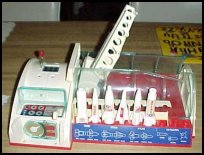
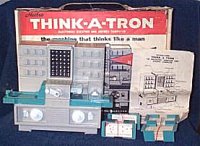
  • id you know that Hasbro put a comptuer in homes in 1967, over 10 years before the Timex/Sinclair and the Commodore 64? Well, its true! Meet the Think-A-Tron. Just pop in two "D" batteries, pick a punched computer card that has the multiple-choice question (A,B,C, T or F) that you want answered, feed it to the machine and push the button. The computer starts whirring. Wheels turn, lights flash and within seconds the correct answer appears on the screen! Try getting an answer that fast on the Web! The questions came two to a card and the cards covered a variety of subjects. The set came with 150 cards, making 300 potential questions that the Think-A-Tron could answer. There was a little holder for each set of 50 cards. You could also buy additional question packs that contained 50 cards/100 questions (all approved by The Book of Knowledge encyclopedia people) about a specific topic, like Sports and Games. The Think-A-Tron is surpisingly affordable. It retailed for around $10 in the sixties and you can find them on sales and auction sites today for $30-$50. They usually work but like most vintage battery-operated toys, the lid for the battery compartment had a tendency to get seperated from the set. The cards, if not properly stored, would develop curls, making it hard to fit them into the computer. http://www.toynfo.com/

    Another GoGoMag.com Website!

    Tuesday, August 11, 2009


    The Time Bomb was made in 1964 by Milton-Bradley and was based on the schoolyard game of Hot Potato. Wind it up and start tossing it in a circle of friends while it ticks ominously. Suddenly it makes a popping sound and the unlucky owner is eliminated from the game.

    Through the years the Time Bomb was released in black and in red. They are quite hard to find now, especially in good condition as the premise of the game did involve tossing and the product was targeted for human beings with under-developed motor skills. Expect to cough up $50-$75 for a clean working example of this fun toy. http://www.toynfo.com/


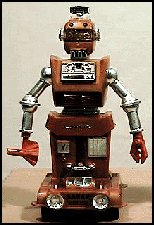
    Zeroids were another product of the space toy craze of the mid-sixties. They were the classic '60s toys, complete with: wacky names, loads of chrome, functionality and tiny pieces that were easily broken or lost. The first three robots were sold in plastic cases that doubled as ramps and trailers. Each Zeroid was able to perform robotic tasks with gripping and throwing, magnetic hands. They sat on top of a square base with tank-like treads that was powered with a battery-driven motorific motor. The figures were able to go forward and backward, courtesy of a switch on their base. The Star Team was initially a great line of child-sized space toys. In the '70s, the Star Team was rereleased with articlulated action figures and smaller, Zeroid-like robots. Zeroids are very difficult to find in mint condition today. Their antennas, trailer hitches, motors and treads are frequently broken or missing. The interchangable hands and their accessories are also a tough find. A complete Zeroid, working with his box and accessories, will easily bring $125-$225 today. Zeroids and Sets
    Zintar, The Silver Explorer
    Zobor, The Bronze Transporter
    Zerak, The Blue Destroyer
    Zeroid and Solar Cycle with Zeroid Robot
    Zeroid Commander Action Set with Zogg, Commander of the Mighty Zeroids
    Zeroid Alien - The Invader from Outer Space with the Computer Brain (HTF)
    ZEM XXI - Zeroid Explorer Module
    Zeroid Sensor Station
    Zeroid Missile Defense Pad


    Early Star Team
    Star Team Child-Sized Space Travel and Reconnaissance Costume Accessories
    Star Team Child-Sized Space Boots
    Star Team Battling Spaceships Game
    Star Team Child-Sized Grippers
    Star Team Child-Sized Space Helmet
    http://www.toynfo.com/


    Copyright © 1996 GoGoMag.com. All Rights Reserved.


    They were made to be the next super-line, a He-Man for the 90's, but they became one of the great action figure tragedies.

    In 1994, Playmates Toys wanted a new line that would be as popular as the Ninja Turtles, who were currently suffering a decline in popularity. The result would be a story about a legion of good guys going after a bunch of evil, living skeletons on the planet Luminaire, a sort of medieval fantasy meets sci-fi.

    According to the story, the evil Baron Dark tries to steal the powerful Lightstar Crystal by tricking the youngest brother of the royal family, who kept it safe, to get it for him . The Baron then split the stone and took the evil half, which caused him, and all who were evil at heart, to become living skeletons. It was then that he formed his Skeleton Legion, whose goal was to steal the other half of the crystal and then conquer the peaceful world of the Luminaries. The good-hearted Royal Family is determined to make sure Baron Dark never gets the other half of the crystal, and the battle of light and dark begins.

    The good guys, The Legion of Light, were known as the Steele siblings consisting of Justin (Prince Lightstar ,the leader), Jennifer (Tayln,who could fly and had a pet falcon) and Joshua (the younger brother, now known as Grimskull due to being turned into a half- skeleton humanoid for his help in dividing the crystal.

    Grimskull, who can "shadow slide"or teleport great distances, must deal with the evil that tries to devour his soul. He was kind of the line's answer to Wolverine or Snake Eyes) Their uncle, Ursak The Guardian (The Team's Weapons Expert), was a 90's version of Man At Arms of the He-Man line.

    The skeletons were lead by Baron Dark, who wears human skulls like medals across his shoulders) . Shriek (originally going to be called Banshee) was the female skeleton whose scream could shatter objects. Dagger was a short skeleton with one eye and a huge axe (but his name is Dagger?) and Aracula a sort of six armed spider/skeleton hybrid. Dr. Cyborn was a half skeleton/half robot who was Baron Dark's scientific expert and high tech weapon maker.

    The detail these figures (especially the skeletons ) is outstanding. Each figure had unique, highly-detailed weapons, one weapon which could be fired by spring loading. Many of them had gold chrome plating on their armor and the skeletons had shiny cold eyes which added to their fearsome look. Figures for both sides had a plastic crystal somewhere on their outfit which was available in an assortment of colors. There are no color variations that are scarce or hard to find.

    The bad guys were the first that were provided with vehicles. Baron Dark had a skeleton horse and a Skull Cycle for his minions to ride. There was also a 3-D video game ,a cartoon on Saturdays and several other tie-ins made for the line.

    One of the action figure collecting magazines, Action Figure News and Toy Review, even did a college like thesis on why it would succeed. The line had retail support and it all seemed poised to be the next super-line. But the line was cancelled after just one year. Why did this line fail? I feel there are many reasons.

    First, Playmates, obviously very impressed with the detail on the skeleton figures, made a mistake of releasing all the bad guys first and not releasing the good guys until in the late summer. By that time, they were reduced for clearance. It is widely felt in the toy industry that villains never sell as well as heroes in action figure lines, that's why we got all those Batman variations.

    Another reason is that a little line called Power Rangers was still sought after by kids while the show was peaking in popularity. The Skeleton Warriors cartoons got moved around frequently which made it hard to establish a following, but the main reason it failed may have been the figures and the story plot were too dark for children. With a bunch of skeleton and skull images blazing on the packages (and on the good guys as well), concerned parents did not want to buy their kids toys which seemed steeped in death and evil. Remember, this was the first year of the Spawn line, whose later figures were horrific, but later was very tame looking in it's first year compared to the figures from Skeleton Warriors.

    I think it is safe to say that the line a little before their time. If they had been released in the current market they would've done great. Also, the color scheme on the bad guys was very dull and plain compared to the colorful Power Rangers, which parents felt were less harmful for junior.

    When retail interest waned and CBS did not order any more cartoons, the toy world cancelled their reservation to see any more battles with the Legion of Light and the Skeleton Legion. The most tragic part of the cancellation was the promise of the prototypes shown for what was to be the 95 season, were never to be made. We would've seen more highly detailed villains, such a Bonezai (samurai skeleton), Sting (a 2 headed scorpion/skeleton hybrid), Claw, and a skeleton who wore Viking battle gear. The first 5 skeletons were also to be released in brighter colors (to compete with Power Rangers) and feature a break-apart feature. A horse and skycycle for the Heroes never got made and all we were left with were the bad guy's accessories. A huge and incredible looking bone dragon for the bad guys to ride was never made, nor was a proposed castle with a huge skull design to it, shades of Castle Greyskull).

    But, the saddest of these losses, was the figure of heroine - Talyn. She was made for the first season but was pushed back for retooling and eventually ended up not being made at all. If they had put her out during the first season, like they planned, I believe that she would've saved the line. Shriek may have been a woman but she was no lady!

    The figures were available for as recently as 2000 at KB outlets for the price of three for 10.00 dollars. None of them are very hard to get but the heroes are a bit harder to find then the skeletons.

    Such was Skeleton Warriors. Despite all of the research done by companies, identifying what will top kid's wishlists is really a guessing game. Skeleton Warriors were an incredible line which had the potential to become toy legend, but will now be remembered as just another fatality in the never ending battle between toymakers to create the next big thing.


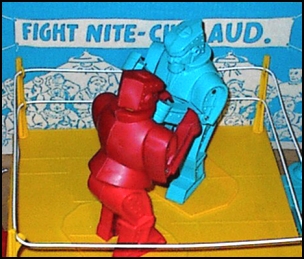
    Rock'em Sock'em Robots were made by Marx in 1966. They required no batteries and were
    completely fueled by children fueled by Fruit Loops and Super Sugar Crisp. The movement
    and the punching of the robots were directed by controllers on either side of the ring.
    The 'bots could move forward and from side to side while throwing left and right jabs.
    Connect just right with your opponent's jaw and his head literally fly off of his shoulders.
    Snap it back down and you are ready for another round!

    One problem with the game, even when they were new, was that one of the Robots almost always had a glass jaw. Sometimes even just a missed punch would jar him enough that his head would come whizzing up, to the delight of the child on the other side of the ring.

    While vintage sets today are usually functional and can even frequently be found with the original box, the score cards, ring posts and ropes are often missing. Also, the "Glass Jaw" syndrome seems to worsen with time.

    For those of you not willing to spend the $200-$500 it will take to pick up a nice vintage set, the Toy Story movie series spawned a new version of the robots that can be had for a fraction of the price.

    The Blue Bomber versus the Red Rocker jar more childhood memories than Ali versus Fraizer. These boxing Robots helped spend the fury of many youngsters in the '60s and '70s, temporarily sparing mother's pictures and fine china. Of course after an hour of clattering and whizzing plastic she may have happily sacrificed a dish or two for some peace and quiet!

    Friday, August 7, 2009

    n the late 80's the world of action figures got a little wacky when a small company called Playmates Toys decided to release a group of figures based upon an independent black and white comic book. In the book, a Ninja Master lives in a sewer along with his four pet turtles. One day an evil enemy known as Shredder pours a strange goo down a man-hole to kill him but instead turns his pets into humanoid animals and him into a large humanoid rat. The Ninja Master (called Splinter) has trained these four teenage animals (named after his 4 favorite Renaissance artists - Michaeangelo; Leonardo; Donatello; and Raphael.) in the art of Ninjitsu and they use their skills to combat evil as the Teenage Mutant Ninja Turtles. The book had a cult following and in 1986 somebody decided a toy-line and cartoon (which would be more kid friendly then the edgier and serious black and white comic book from which they sprung) would be a perfect way to flesh them out.

    The TMNT (common collector's acronym)were a stark contrast to the current lines of popular figures which had serious story lines. The turtles were wacky, practically comical in their attitude (complete with surfer jargon, and a love for pizza and partying) and this made them a huge success throughout the late 80's and early 90's. It marked in a new type of action figure era, the era of the wacky animals. To longtime fans of the comic, this new line was a watered-down version of the book characterizations made to appeal to kids. Of course the kids couldn't care less and instantly began buying up every figure and related product which had the four green teens' faces on it. Who could forget the return of the word "Kowabunga" (an old surfer term originally popularized by Chief Thunderthud on the Howdy Doody show) to the nation's vocabulary?

    What products bore the likeness of the Toxic Terrapins? What products didn't? After the initial release of the first four figures it seemed everything from pillows to cereal, as well as three live action movies, had the four turtles' faces on them. You couldn't get away from them no matter where you went. The main draw was of course the toys. Figures of the four turtles and their friends (like April O'Neil; Mondo Gekko; Ace Duck; Wingnut; and Usagi Yojimbo who had his own independent comic book) and the villains (Shredder; Krang; Beebop; Rocksteady; Ground Chuck; Baxter Stockman; and the Scmbug) sold out nearly every time they got put out on the shelves.

    The four turtles would see the most variations of any figures at that time. There were over 150, with everything from Headdropping Turtles to Star Trek Turtles. Fans had quite a few versions of their favorite mutant teenagers to choose from. You can't forget the vehicles that came out such as the Party Wagon; Turtle Blimp; Ninja Grappler; and other strange and wacky things for the good and bad guys to drive.

    It seemed like you couldn't escape the phenomenon but, like everything else, nothing lasts forever. Especially in the world of toys. In 1993 a line called Power Rangers burst onto the scene and while the TMNT line continued on, it never reached the fever pitch it had in the early 90's.

    In 1998 it was decided the line needed a revamping. Fans were given a new live action show, ironically made by Saban entertainment whose Power Rangers show and toys kicked the turtles out of the top spot, and a new name - "Ninja Turtles, The Next Mutation", and the toy line was created. Despite their best efforts (including adding a new sister turtle called Venus De Milo) it just didn't do well and got cancelled after a short lived second season of toys. There had been such a glut of the original line that the new line just wasn't accepted by the fans. The era of the wacky animals was over after a nearly 10 year run.

    Today, the figures haven't appreciated much in value. Like the Masters of the Universe before them, they were so mass produced you can still find them just about everywhere on the secondary market and in flea markets for very little money. Mint on card figures, however, are just now beginning to come up in price, with the most expensive being the figures of the four turtles from them first season. The fab four can bring $25 to $40 dollars each. Also gaining value are figures like Leatherhead, the evil cajun gator man, (who was pulled from the line after his release in '89 because he didn't sell) and the '90 April O'Neil, the reporter with the "press" badge which gained infamy after a rumor got started that parents complained kids were pressing on her breast because they thought that's what the badge meant. The truth is they got rid of it because it was too expensive to keep the "press" paint job. The rest of the line of whimsical figures have yet to increase dramatically in value but there is no doubt that when the children who made the TMNT so popular grow up, they will once again take another trip to the sewer to get reacquainted with those Ninja-fighting, pizza-eating, mutant teenage turtles.


    Quite often, when I would pick up a vintage attic or basement toy collection, I would notice
    a couple of broken 8-inch battery-operated space vehicles called Moon Scouts. They never
    ran and were always missing stickers or essential accessories like grabber-arms or satellites.


    I looked in my toy books and searched the web and couldn't come up with any information
    on these space toys. Occasionally I would see them on sales or auction sites going for
    next to nothing. I decided to compile what I do know about them and make it available for
    you here. They must be hard to find, certainly in good condition, because there is so
    little data available on them. If you know anything about 'em, please don't hesitate to
    drop me a line.


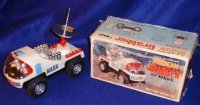
    I believe that the Moon Scout line covers at least a decade, probably from the early '60s to
    the early '70s. I think that the double-bladed helicopter is one of the earlier uses of the
    Moon Scout name and the Moon Grabber series is the latest. The Moon Grabbers, which are the
    vehicles that I kept stumbling on, are about 8 inches long. They are battery operated which
    propels the 4 wheel drive forward or in reverse. They are white plastic with big all-terrain
    tires (they can climb up a 30" incline), chrome accessories and clear plastic windshields
    and bubbles. They came with NASA, Flag and Moon Scout stickers and 2 silver astronauts in the
    front of the vehicles.


    As I indicated earlier, the vehicles almost never work and are frequently missing the
    fragile plastic arms, blades and accessories. The clear plastic in the windshields are
    very susceptible to melt marks.


    The helicopters and the 8 legged walker can cost as much as $25-$40. The Moon Grabber
    series can be found alone or in toy lots for well under $20. I've got maybe a dozen
    and have never paid more than $10 for one.